Let’s be direct: OSHA does not mandate digital checklists. The regulation at 29 CFR 1910.178(q)(7) requires that forklifts be examined before each shift and that defective trucks be removed from service immediately. It does not specify what format the record must take. Paper is legal.
The question isn’t whether paper can technically comply — it’s whether your paper records will hold up when an inspector asks to see them. In fiscal year 2025, Powered Industrial Truck violations ranked among OSHA’s top ten most-cited standards, with 1,826 citations nationally and more than $15 million in penalties in 2024 alone. Documentation failures — not equipment failures — are among the most common triggers.
What the regulation actually requires
Under 29 CFR 1910.178(q)(7), every powered industrial truck must be examined before each shift. Any unsafe truck must be removed from service immediately. The regulation does not prescribe a specific format, required fields, or a mandatory retention period. The full standard text is available at 29 CFR 1910.178 — section (q)(7) covers inspections; section (l) covers operator training and certification requirements.
What OSHA inspectors request in practice: logs identifying the forklift (unit number or serial), the date and shift, the operator name and certification status under 29 CFR 1910.178(l) — which requires operators to be trained and evaluated before operating any powered industrial truck — items checked, defects found, and resolution confirmation. Best practice points to 1–3 year record retention. The gap between the literal text of the regulation and what survives auditor scrutiny is exactly where paper systems run into trouble.
Where paper records consistently fall short
Paper can record what happened. It cannot verify when — or who.
A checklist completed at 7 AM looks identical to one filled in at 5 PM after an incident. There is no mechanism to prove, or disprove, when it was completed. OSHA auditors are trained to identify signs of retroactive completion: forms that look too uniform, ink patterns suggesting batch completion, dates that don’t align with shift records. This is not an accusation — it is an observation that you cannot prove otherwise, and in an enforcement context, that distinction matters.
Operator identity presents a parallel problem. A signature does not confirm that the person was trained and authorised for that specific vehicle type under 29 CFR 1910.178(l). A PIN shared between two operators proves even less.
Defect records compound the issue. Paper consistently captures defects found — but rarely the full resolution: who was notified, when the truck was cleared, and by whom. A documented defect on a truck that remained in service makes the liability situation significantly worse, not better.
Finally, retrieval. A request for 90 days of inspection records on unit #7 should take minutes. With paper filing systems, it typically takes hours — and the results are frequently incomplete.
The outcomes that matter — beyond the fine
Serious OSHA violations under 29 CFR 1910.178 carry penalties up to $16,550 per citation. Willful or repeat violations can reach $165,514. But the more significant impact for most operations is what happens around the citation: equipment out of service, investigation time, insurance implications, and reputational cost with customers and insurers.
What changes when compliance becomes automatic: XQ360 by Collective Intelligence Group
The Safety Managers who describe OSHA audits as low-stress events share one characteristic: their compliance records exist continuously, built as a byproduct of normal operations — not assembled before an inspection.
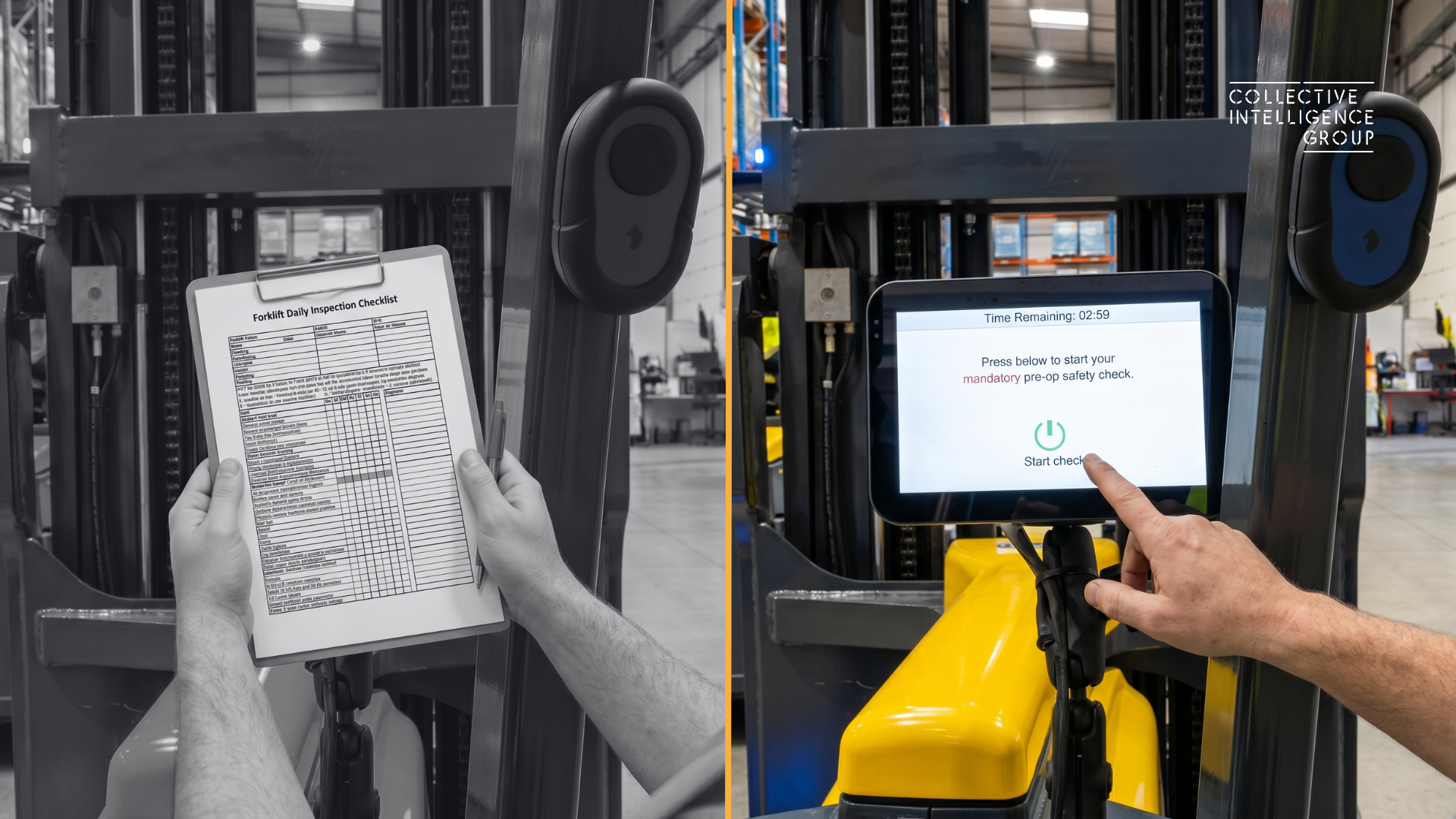
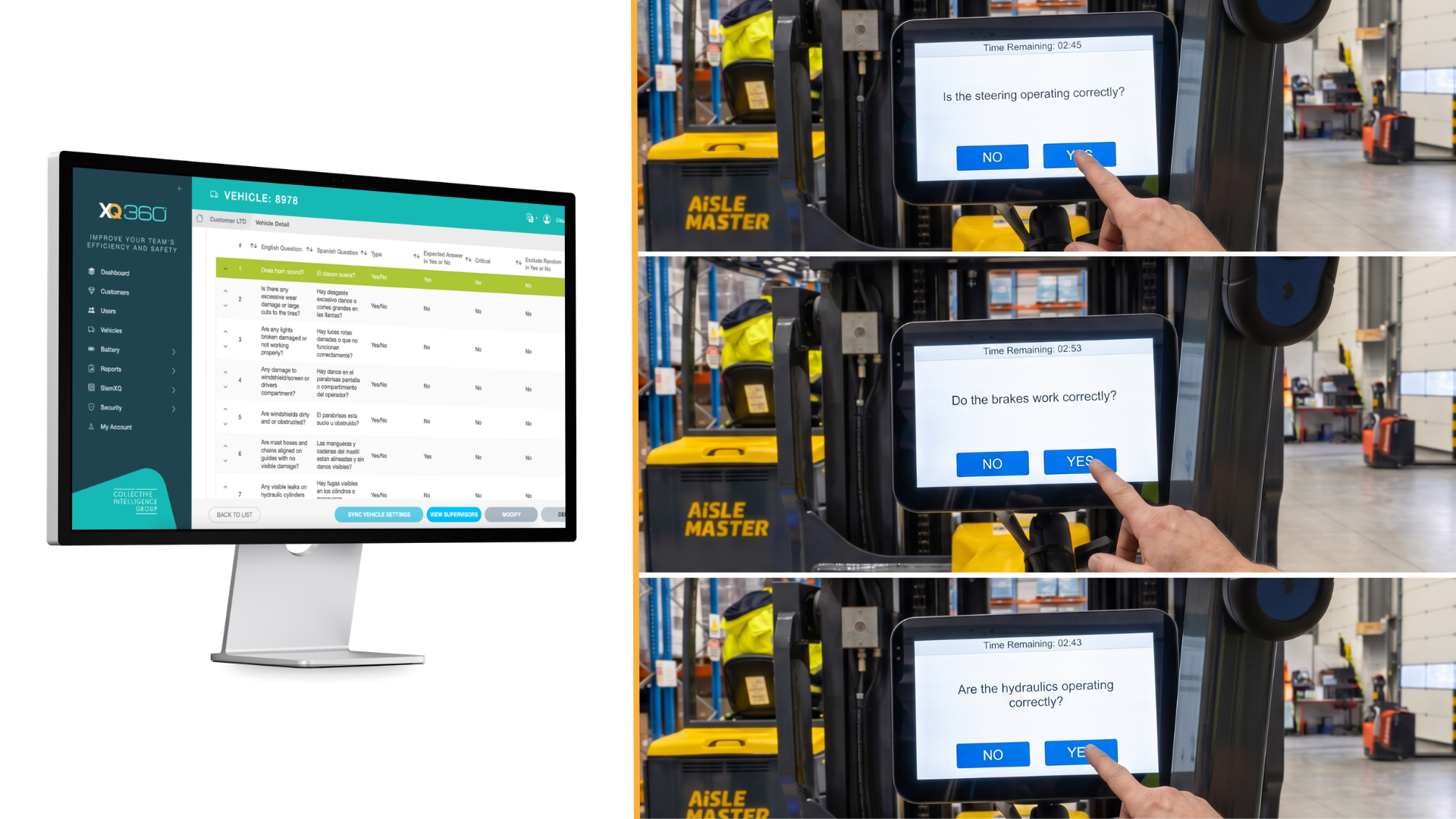
That means individual authentication at the access point. Each operator logs in with their own PIN before the vehicle starts. The pre-shift checklist is required before the session begins. Any defect triggers an automatic supervisor alert and blocks the vehicle from re-authorisation until the issue is resolved. The full session history — operator, vehicle, time, checklist result — is logged automatically and exportable in the format OSHA auditors expect.
XQ360 by Collective Intelligence Group builds this into every vehicle in your fleet. Individual PIN per operator — shared credentials are not possible by design. Checklist required at every login. Automatic defect escalation with blocked re-authorisation. Records filterable by vehicle, operator, or date range, exportable in under five minutes.
The operational benefits go beyond compliance. Checklist completion rates improve when individual accountability is visible. Recurring defects on specific vehicles surface earlier. Supervisors spend less time on manual reporting and more time on work that requires their judgment. Compliance becomes a consequence of good operations — not a separate effort layered on top.
Frequently asked questions
Can paper checklists satisfy OSHA 1910.178(q)(7)?
Yes, if completed consistently and accurately. The challenge is maintaining that standard across shifts and operators, and being able to defend timing, attribution, and completeness when an auditor looks closely at a specific record.
What are OSHA fines for forklift inspection violations in 2026?
Serious violations carry penalties up to $16,550 per citation. Willful or repeat violations can reach $165,514. In fiscal year 2024, forklift-related violations generated over $15 million in total penalties nationally.
How long do forklift inspection records need to be kept?
OSHA does not mandate a specific retention period for daily records. Best practice points to 1–3 years. The more important point: records need to be retrievable quickly. Records that technically exist but take hours to locate offer limited protection during a time-sensitive audit.
How does XQ360 make OSHA forklift inspection records audit-ready automatically?
XQ360 replaces the paper pre-shift inspection process entirely. Each operator authenticates with their individual PIN before the vehicle can start — shared credentials are not possible for security. The system requires the pre-shift checklist to be completed before the session begins, automatically timestamping the record with the operator’s identity, vehicle ID, and checklist result the moment they finish. If a defect is flagged, a supervisor alert fires immediately and the vehicle cannot be re-authorised until the issue is resolved and confirmed. When an OSHA inspector requests 90 days of records on a specific vehicle, a Safety Manager using XQ360 can produce that report — filtered by vehicle, operator, or date — in under five minutes.