If your fleet runs more than one brand of forklift — in a warehouse outside Chicago, a distribution centre in Manchester, a plant in Monterrey, an operation in Bogota, or a site in Melbourne — you are probably already living with visibility gaps you stopped registering as problems. They became part of how operations work.
They are not. They are the cost of running a fleet without unified visibility — real, measurable, and in most cases already somewhere in your budget. Just not labeled.
We have seen the same pattern repeat across every market we work in. The numbers change — the currency, the regulation, the loaded rate of the person doing the reconciling — but the five gaps themselves do not. Here is the pattern itself. If you want the cost figures and the regulation that applies specifically to your country, there is a version of this built for exactly that — more on that below.
Why these gaps stay invisible
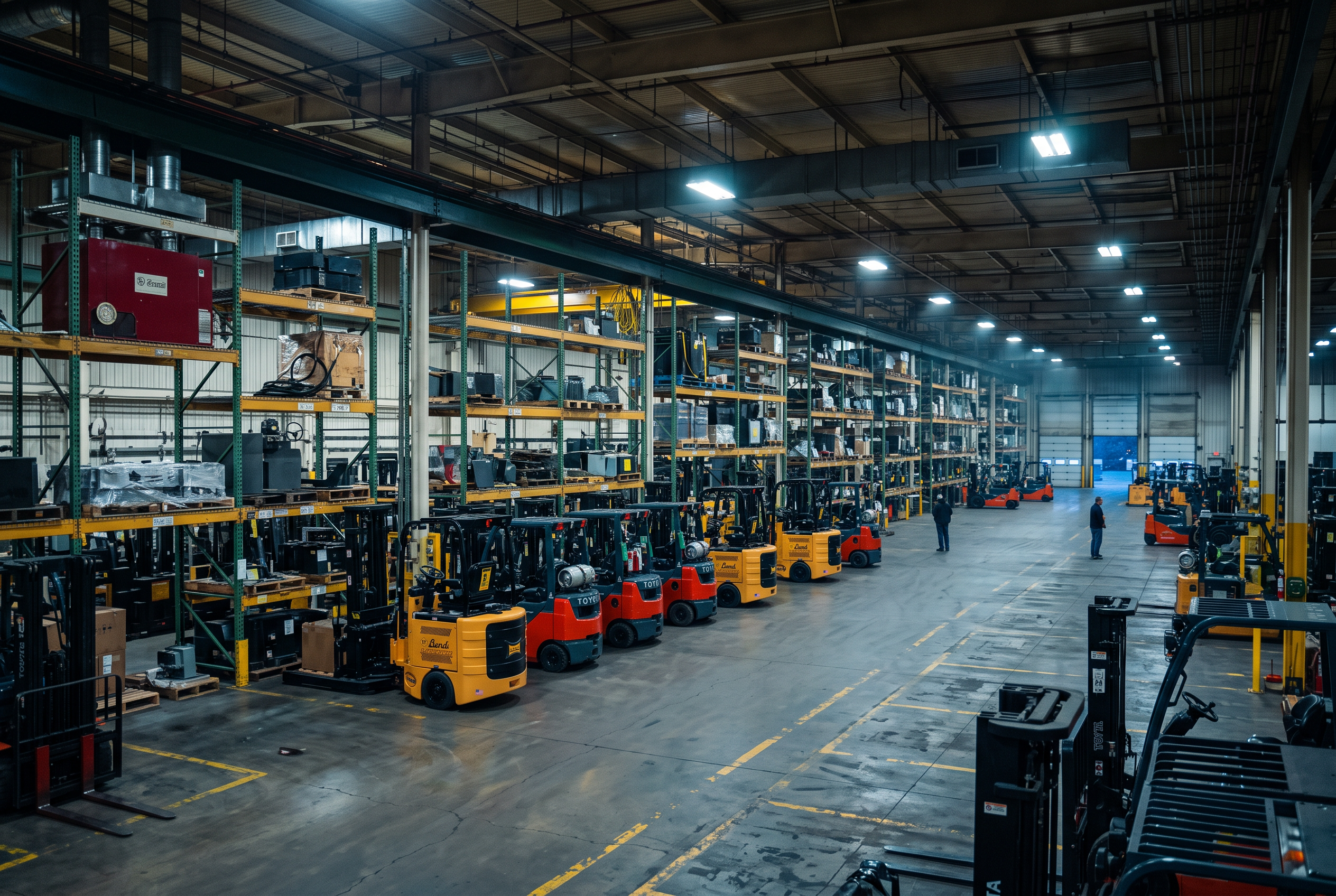
None of this shows up as its own line item. There is no invoice for ‘time spent reconciling three dashboards’ or ‘liability exposure from a shared credential.’ It gets absorbed into normal workload, spread thin across shifts, roles, and sites, until it stops looking like a cost and starts looking like just how the job works.
That is precisely what makes it expensive. A cost nobody names is a cost nobody budgets to fix — and a fleet running three or four unconnected systems keeps absorbing it quietly, indefinitely, unless something forces the reconciliation to happen.
The five signs
If more than two of these sound familiar, you are likely already paying for low visibility — it just is not showing up as its own line item yet.
- Multiple logins to see your whole fleet. Every brand has its own dashboard. If seeing your full fleet means opening three or four different tabs, you do not have fleet visibility — you have brand visibility, multiplied.
- A shared credential just to run daily inspections. Without a single login that can check every unit, supervisors either juggle a separate PIN per machine or fall back to one generic code — which quietly cancels out the individual accountability the credential was supposed to provide.
- Damage shows up days later — and nobody can say who was driving. Without individual operator authentication at the vehicle level, every incident becomes an investigation instead of a data point.
- One cross-site report takes hours, every month. The data exists. It is just spread across different systems, in different formats, waiting to be reconciled by hand before anyone can read it as a single picture.
- No way to tell which units are overworked and which sit idle. Without comparable utilization data across brands, there is no way to balance the load — which quietly shortens the life of the equipment carrying more than its share.
None of these five are separate problems. They are symptoms of the same condition: a fleet where the relationship between operators, equipment, sites, and data is not visible in one place.
The regulatory angle nobody budgets for
Every market we work in treats operator certification and equipment maintenance as a legal obligation, not a best practice — the mechanism just looks different from one country to the next.
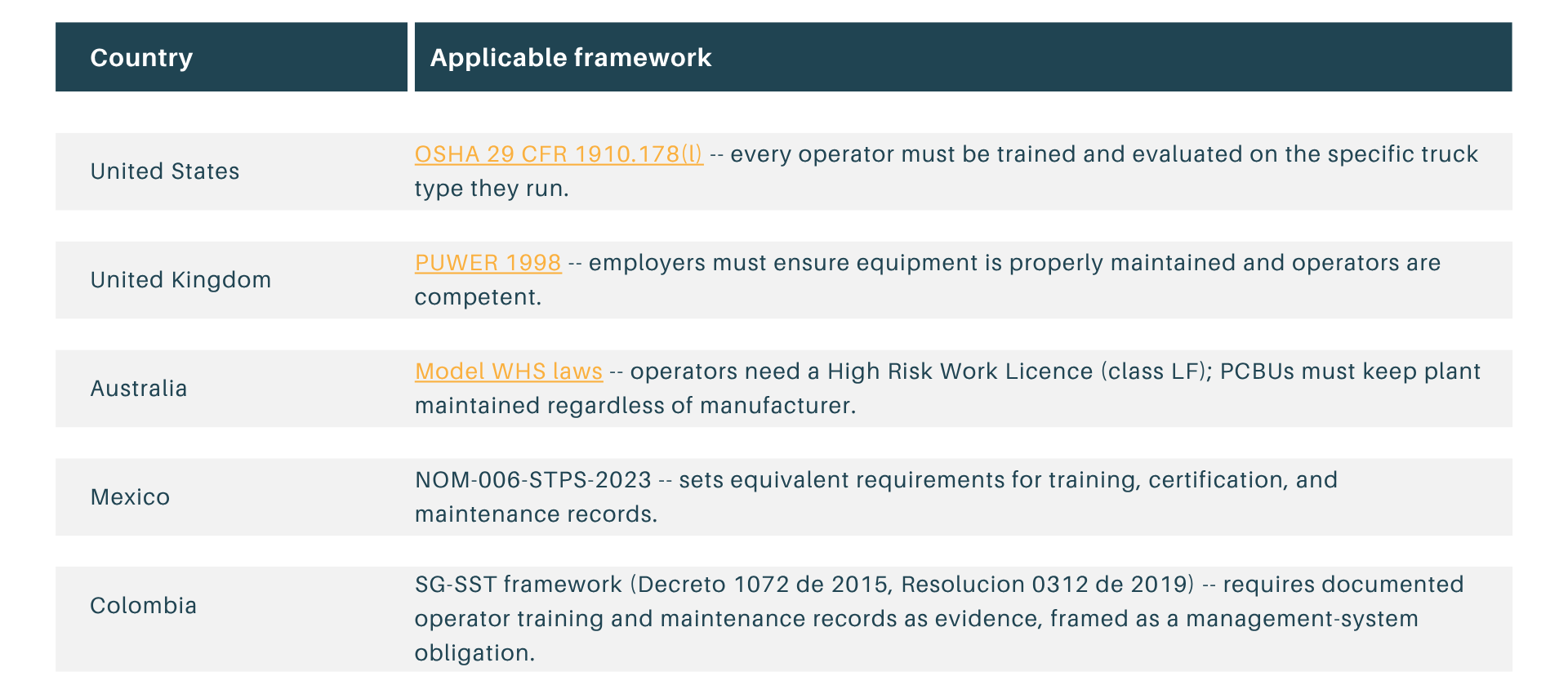
In a mixed-brand fleet without a unified system, each of those obligations gets proven separately, per manufacturer, per site. That is not just inefficient — in an audit, or after an incident, it is the difference between producing one record and reconstructing five.
What unified fleet visibility looks like: XQ360 by CIG
The five signs above are not separate problems, wherever your fleet operates. They are symptoms of the same underlying condition: a fleet where the relationships between operators, equipment, sites, and data are not visible in one place.
XQ360 by Collective Intelligence Group connects every brand and every site in your fleet into a single view — with individual operator authentication, indoor tracking that does not drop out where the operation actually happens, real-time alerts, and reports that take minutes, not hours. Used across 25,000+ active systems on five continents, it connects to the equipment you already have without requiring replacements.
What Fleet Managers consistently tell us matters as much as the platform is what comes after installation. Every XQ360 customer receives five years of unlimited personalized training — using their own data, on their own dashboard — at no additional cost. When operations change, the training adapts. That is not a standard in this industry. At CIG, it is the baseline.
Frequently asked questions
Can XQ360 connect to different forklift brands at the same time?
Yes. XQ360 is brand-agnostic and connects to any forklift regardless of manufacturer. Mixed-brand fleets are the primary use case the platform was built for — the entire point is to give operations a single view of all equipment, regardless of how many brands or systems they currently run, or how many countries they operate in.
What happens when an operator uses someone else’s credential in XQ360?
XQ360 requires individual authentication before a vehicle can start. Shared access is not possible by design. Every session is logged with the verified operator identity, vehicle ID, and timestamp — so the operator record reflects who was actually operating the vehicle, not whose credential was used.
How long does it take to pull a cross-brand, cross-site report in XQ360?
Reports filterable by vehicle, operator, site, or date range are available in under five minutes. All data lives in a single platform — no export-and-reconcile step required, even across countries.
How does XQ360 handle indoor tracking where GPS does not work?
XQ360 uses alternative positioning methods — including ultra-wideband (UWB) — that do not depend on GPS signal. Indoor tracking remains active regardless of whether equipment is inside a warehouse or multi-level facility.
How does XQ360 help balance utilization across a mixed fleet?
XQ360 tracks real usage per vehicle — hours of operation, operator sessions, impact events, service intervals — across every connected unit regardless of brand. With comparable utilization data across the full fleet, operations can identify which units are overworked and which are underused, and adjust workload and maintenance schedules accordingly.
Does XQ360 handle regulatory requirements differently by country?
XQ360 keeps operator certification, training records, and maintenance history in one system regardless of where a site sits — so whichever framework applies locally, the evidence a company needs to produce is already organized and exportable, instead of reconstructed after the fact.